

How to grow as a leader: Uncover your beliefs

In Essential qualities of amazing leaders I presented a working definition of a leader, with five essential qualities that define an effective, influential leader. Today we’ll start a series of articles to dig a little deeper into the first quality.
A leader formulates a vision that is aligned with their values and beliefs.
Those are some big concepts! In the next few articles, I’ll work my way from the end of this sentence to the start, with articles about beliefs, values, vision, and alignment. Each article will include a brief overview of the concept followed by one or two inner tools you can use to explore it further. In time I’ll add worksheets or info pages (“cheat sheets”) to make those inner tools even easier to break out and use. So let’s get started with beliefs!

Beliefs
What do I believe? What do you believe? Understanding your beliefs can be challenging because they live at a foundational level, underlying our conscious thoughts and behaviors. This means that our behaviors are often guided by our beliefs whether we have consciously explored them or not. According to John Eades of Learnloft, a belief is a pattern in the brain, laid there through experience and repetition. This matters because our beliefs become our behaviors.
Beliefs aren’t necessarily good or bad. However, they can be helpful or unhelpful. For example, many believe that we must spend our time doing “productive” things, and that rest and hobbies don’t count as productive. If you hold this belief, then you may feel guilty when you take a break, or you might be unable to relax because your mind stirs you to action when you sit down to watch your favorite TV series. And if you hold this belief at a subconscious level, then you may not know why you feel driven to work on a meal plan or find laundry to fold instead of relaxing. One good general rule, if there’s something in your life that you really struggle with, that makes you feel all the feels, there’s often a belief hiding out in the shadows.
So here’s the good news: we can change our beliefs. Katie Sullivan Porter of The Leadership Circle writes that the best part about our beliefs is that we can challenge them and shape them and completely rewrite them. In fact, the final item on her list of the 7 Core Beliefs that Shape Extraordinary Leaders says
Beliefs can change—and that changes everything.
And she’s right! When you believe that you can change your beliefs, you find many more opportunities around you that you may have been unaware of… or may just have believed impossible. Changing beliefs is a mindset effort, and like so much inner work, making the change relies on conscious intention and self-talk.
We’ll talk more (much more!) about beliefs and changing them in coming articles. For today, let’s start with an inner tool for discovering our beliefs.
When we uncover our beliefs and reflect on them, we can change them. If It’s a mindset effort, and we have to practice telling ourself the new belief. It’s about consciously challenging this pattern in the brain so that we can shift it to where we want it to be.
Inner tools in practice
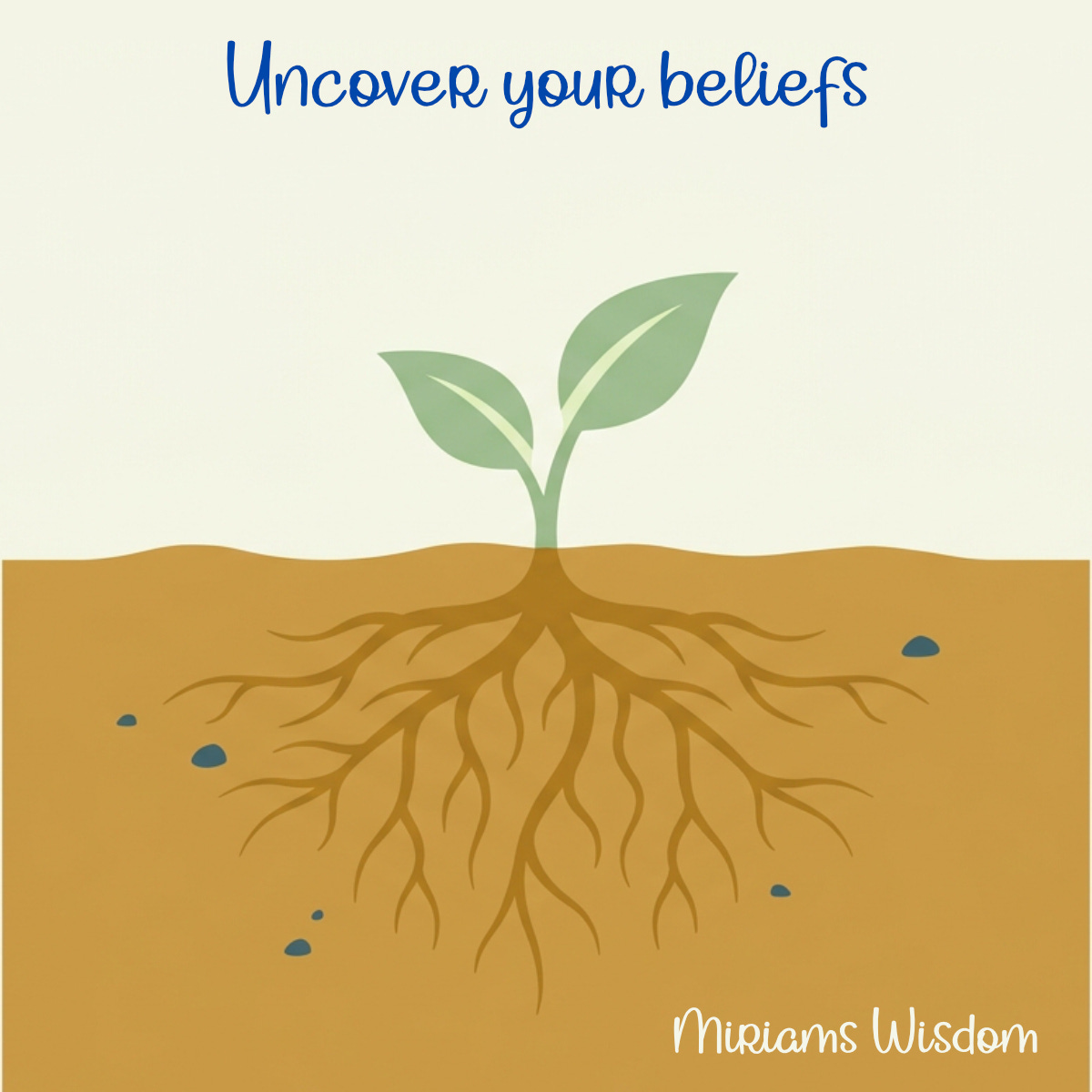
What do I believe?
A brainstorming (or ideation) exercise can be helpful for exploring your beliefs. For this you’ll need pencil and paper or your favorite app for mind-mapping or note-taking.
Before you begin, write down four or five prompts for getting started:
What do I believe about success?
What do I believe about work?
What do I believe about people?
What do I believe about power and influence?
What do I believe about being worthy or even valuable?
What do I believe about time, money, joy, satisfaction…?
There are so many prompts you can try, and some may be more fruitful than others. The good news is, you’re spending 10 to 15 minutes max on this exercise, so if you want, you can try it again tomorrow with different prompts.
Set a timer for no more than 5 to 8 minutes, and hold yourself to that.
Start the timer and respond to the categories. It’s okay to branch out or add more.
While the timer is going, try to keep your focus on a flow of ideas. You can review and reflect on your findings later. And don’t be afraid if you only come up with a few. This particular brainstorm tends to yield maybe 5 to 10 ideas instead of 20 or 30.
Our beliefs become our behaviors.
How do my beliefs affect me?
Maybe the next day, return to your list for reflection. If you want to make yourself a neat copy of your beliefs before you start, go for it. You’ll need your list(s) from brainstorming, and you’ll want pen/paper or your note-taking app as before.
Set a timer for no more than 15 to 20 minutes.
As you review each belief, ask yourself some reflection questions: What benefits do I get because I hold this belief? How does this belief expand my influence and vision? What does it cost me to hold this belief? How does it restrict my viewpoint or sap my energy? Where did I pick up this belief: as a child, in school, at work? How do I feel about this belief? Am I 100% for it, am I not sure, or do I think I need to change it?
Jot these down as you work through your beliefs. It’s okay to not be sure, especially when we’re working quickly. Try to get something down for each belief.
Don’t try to brainstorm new beliefs while you do this reflection. If something comes up that you didn’t think of before, then go ahead and put it down, of course. The idea is that while the timer is running, your focus is just on reviewing and reflecting. Sometimes the activity of putting beliefs down on paper reveals what you need to get unstuck or to grow to the next level. Sometimes you’ll need to take it farther… and we’ll talk more about what that can look like in a future article.
Wrapping up
We opened with just one of the essential qualities of a vital, influential leader, and in this article, we focused on just one concept from that quality.
A leader formulates a vision that is aligned with their values and beliefs.
Of course, it’s hard to judge whether our vision as a leader is aligned with our values and beliefs if we don’t even know what beliefs we hold! So we introduced two inner tools for exploring and uncovering beliefs. This is such a rich area for self-discovery that it will come up again at Miriam’s Wisdom.
After you try one of the tools, please feel free to leave a comment about how it went. Was it easy or difficult? Did you learn something amazing, or did it seem like a waste of time? Did you try something a little different, maybe a variation on the tool?
And stay tuned for the next article about values, which will come out in 3 to 4 days. See you in the comments!