

How to grow as a leader: Alignment

In Essential qualities of amazing leaders, I presented the working definition of a leader, with five essential qualities that define a vital, influential leader. Today’s article is the last one in our series about the very first quality:
A leader formulates a vision that is aligned with their values and beliefs.
We’ve been working our way from the end of that statement to the start, discussing beliefs, values, and vision and providing inner tools for exploring each one. By using those inner tools to learn more about yourself and your leadership, you gain a better understanding of your past—where you’ve been—and your future—where you want to go. Today we’ll wrap up the series with alignment, which shows how well our beliefs, values, and vision fit together to make you successful.
Alignment
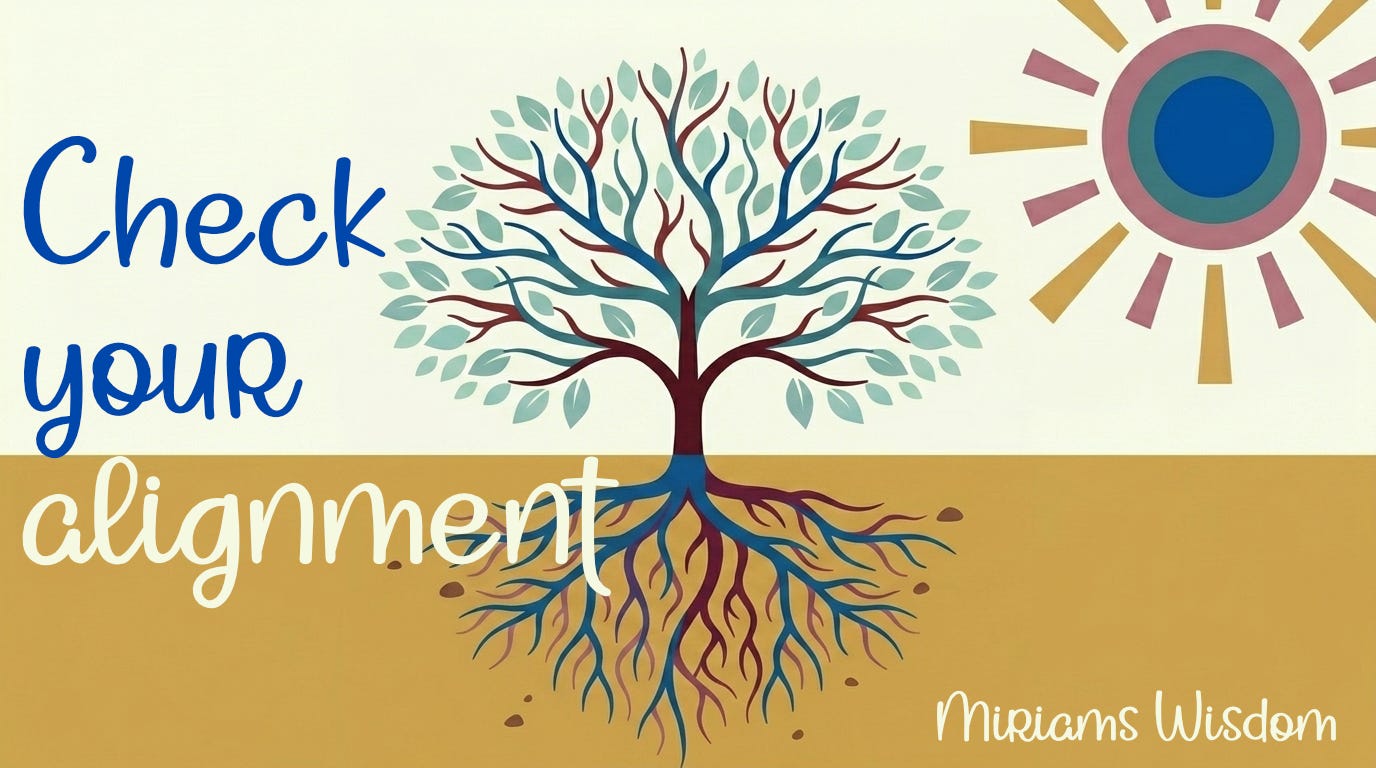
Alignment is what brings the concepts of beliefs, values, and vision all together. Misaligned beliefs, values, and vision can add struggles and stress to your journey, causing detours and curves and speed bumps. Well-aligned vision, values, and beliefs, however, can lead to a smoother journey along the freeway, without all the twists and bumps and detours. Rocky, winding roads don’t prevent you from getting to your destination, but they make you work harder than if your roads are straight and clear.
The Brain First Institute discusses alignment between our values and our goals through a story of a young architect named Malin. Malin has a vision of being a renowned architect, has a belief that success would require “total commitment” to the vision, and holds values for connection, relationship, and creativity. In the story, Malin realizes that her belief about total commitment was misaligned with her values, and she revises her vision and her actions to bring harmony among the vision, beliefs, and values. Unfortunately for Malin, she recognized the misalignment only in retrospect, because she was approaching burnout, stressed and exhausted, and feeling disconnected from her family, her creativity, and her own spirit.
However, I don’t want you to burn out before you recognize misalignment among your beliefs, values, and vision. Instead, I’d like to equip you with inner tools that you can use immediately to detect possible clashes, learn about them, and make adjustments to prevent rough passages on the road to achieving your vision. Here’s where it really makes a difference that you can change your beliefs and your values. You’re even allowed to adjust your vision! This is why Miriam’s Wisdom is here: to give you the techniques and tools you need to thrive as a leader without burning out or losing your soul.
Why alignment matters
When your vision is aligned with your beliefs and your values, you can put your whole self into achieving your goals. If you’re in a situation where there is conflict between some beliefs and some values, as Malin was in the story above, you’re likely to feel frustrated and stressed. You may not know why. It takes active exploration of your beliefs and values to notice what is happening at a subconscious level.
The response to all the chaos out there is to look inward, ground yourself in your beliefs and values, and then act out of the deep truth of who you are.
When you’re leading a team, your team members are looking to you and your behaviors to model for them the ways they should act. They will notice if your actions and decisions follow from your values and your vision, or if they appear to contradict your values or work against your vision. This can cause your team members to feel distrustful or even to show behaviors that are out of alignment with where you want the team to go.
Inner tools in practice
Alignment is about connection and harmony among your beliefs and your values and your vision. If you’ve already taken the time to ideate and reflect on your beliefs and your values, and you’ve done some visualization work on your vision, then you’re well prepared to assess their harmony. Today’s work is more centered in your head than in your heart, and ultimately, it all needs to feel right in your gut.
The Observer
For the inner tool of the observer, you’ll need
Your notes, sketches, or doodles from the visualization tool for your vision
Your notes (etc.) from the ideations for your beliefs and values
Any further notes (etc.) you made during review and reflection
Your favorite note-taking app or pencil and paper for today’s observations
Because we’re looking at connections today, you might find a mind-mapping app helpful.
Before you start, tell yourself “I am an observer. I am here to observe my beliefs and values and leadership vision. I am not here to judge, only to observe and make note.” When you’re ready, start a timer for 15 to 20 minutes and begin.
First, take a look at the notes you made when using the inner tool of visualization to formulate your vision. Review what you saw and felt during your visualization. I encourage you to try to imagine holding your leadership vision in your hands, feeling its weight or its lightness, its fluffiness or density, its smoothness or softness or coarseness. Maybe it’s easier for you to imagine seeing your vision as a sculpture or hearing it as music. What do you observe? What feelings are aroused? Do you feel energized or tired by examining your vision? Remember, you’re here as an observer, to see and make note, and not to pass judgment.
Once your responses start to slow down, look at your beliefs and values, at what came up in ideation and when using the inner tool of review and reflection. Do any of them feel like your vision? feel very unlike your vision? If it helps, imagine your vision as a neighborhood, and you’re out for a walk. Do your beliefs and values fit well in this neighborhood? Do any of them stick out like a sore thumb? Where do you notice harmonies or clashes? Remember, you are the observer here. It is not bad or unworthy for something to be out of place.
As you explore your beliefs, values, and vision together, observe your own responses. What are the feelings that arise? Where are you tempted to pass judgment—for or against? Remember that your role is to observe, not to arbitrate disagreements or demand change. Make notes of what you see and feel.
As your time draws to a close and you re-enter the world, it’s okay to thank yourself for this time of inner work. Make time tomorrow or the next day to review your notes and reflect on what you learned from them.
Visualization
Visualization is a helpful tool when you’ve found potential conflicts among your vision, beliefs, and values. Today, you’ll visualize a scenario, a “what if” scene to play with these ideas. For this exercise, you’ll need
Any notes about a potential conflict you’ve identified
Your favorite pen and paper or note-taking app
A timer set for 10 to 12 minutes.
In this visualization, you’ll begin by bringing up your leadership vision. Instead of visualizing it already accomplished, imagine yourself along the way to achieving it. An issue has come up, something that might prevent you from reaching your vision. A belief and/or value (or more than one) that you suspect might be misaligned with your vision has come up. Imagine what this feels like. What thoughts occur to you? The people that really matter in your life—your partner, your children, your boss, your parents—what would they say?
Perhaps you need to collaborate closely with someone to achieve your vision, but you’re tired and anxious and don’t want to continue. It might be that your value for solitude and reflection is getting pushed aside. Without the time to be with yourself and reflect, you may no longer be able to keep motivating yourself to achieve the goal. It may feel like the price is too high… and maybe it is… and maybe it isn’t.
You don’t have to resolve the potential conflict today. Your goal is to surface possible responses, not only your typical response in the moment but other ways you might approach the misalignment.
After your visualization time is up, you may feel unsettled. It’s a good time for a break: a quick walk or a refill at the water cooler or watching a video of purring cats for a few minutes. Strategies for nervous system dysregulation might also be helpful. Most of all, you need to give yourself permission to feel like you’ve just been in the middle of a conflict—because you were!—and to need a few minutes to return to your regular day.
Additional resources
Guide to Values Alignment in Leadership, very team-focused
Inner Alignment: How Needs, Wants, Values, and Traits Shape our Lives, more individual and inward focused
The Power of Alignment: Using Vision and Values to Create High Performance Teams, team-focused academic paper
Wrapping up
This concept of alignment is abstract and difficult to describe. Sometimes it helps to have a partner or mentor you can discuss it with, especially if you’re not sure whether there’s a misalignment among your vision, values, and beliefs. Sometimes you do the inner work and don’t feel satisfied. This is okay. You don’t have all the answers, even about yourself. You didn’t even get an operator’s manual for using your own brain, that amazing, complex machine. When you show up and you do the work, you will notice results. Maybe not right away. But showing up, being present, and committing to the inner work build a new pattern for your brain, one that might eventually become a belief or a value on its own:
“I believe that I’m someone who shows up.”
“Showing up and doing the work are an important commitment.”
“I believe I get the best outcomes when I truly commit to work I need to do.”
Maybe yours is different. It’s all within you to discover: the amazing leader you already are.
I realize that this journey hasn’t taken us all the way to a solution yet. We’ve uncovered our beliefs and found our values, we’ve formulated a vision and assessed it for alignment, but… what now?
There are two main directions to go from here. One direction is to resolve those misalignments, which typically means we have to change something in one or more of our beliefs, values, and/or vision. There are plenty of inner tools and techniques for changing patterns in the brain, and we will talk more about them. The other direction is the next essential quality of an amazing leader: An amazing leader thinks, plans, and acts to bring their vision to life. As with the first quality, there’s a lot of unpack in that brief sentence, so we’ll start working on it in a few weeks. You can expect a series of articles, perhaps on thinking, planning, acting, and what it means to have a living vision.
Sound exciting? or not really? I’d love to know what you’re looking forward to next. What are the things you wonder about—or worry about—as a leader? Let me know in the comments!